|
| “What would it take to change your mind about things you think are true at this time?” |
Good Morning Dr. Van Dixhorn! Thank you so much for visiting with me here at Book Readers Heaven. First, do you mind if I call you John since we're of the same age range? LOL
Please feel free to call me John in the same way I call you Glenda.
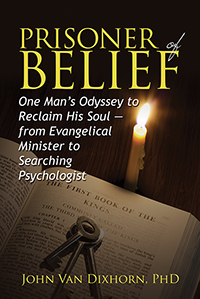
You've already read my review, but like I said when I first contacted you, for some books, I like to go further into the book and discuss important issues you covered. Prisoner of Belief is certainly one of those books! I love the title, but, still, would like to hear how you came to name your book? And also, what led you to write your book?
I define a “prisoner of belief” as someone whose mind is
controlled by a dogma that cannot change with new information. If you ask someone who thinks Evolution sets forth
certain truths, “What would it take to change your mind about things you think are
true at this time?” They immediately could point to a number of discoveries
that could be made that would change things for them.
To the prisoner of belief
no new information would change anything.
They are locked into a box and cannot think outside of it. All their intelligence goes into defending
the dogma. And the more absurd the dogma
the more intelligence it takes to defend it. We do not have scores and scores
of church councils for nothing. They
were badly needed to defend orthodoxy and nothing more. There are a few very special theologians I
have studied who have said, “It is very possible that God doesn’t exist, but
here are the reasons I think he does.” I
do not call these Theist, “prisoners of belief.”
Or, perhaps like me, many had rejected the dogma and just went on from there???
Or, perhaps like me, many had rejected the dogma and just went on from there???
Going public with a book about my psychological journey of discovery was more a personal record of my religious journey, than a desire to get involved with a lot of public discourse. I felt if I did not define myself around these difficult issues, many people I know would like to define me in ways that were not true - like "John really wasn't an atheist, he was more..." and after I die I have no power over how people would define me. Isn't this the sad story of Jesus? He never wrote anything. We only have a record of how he was defined 50 years after his death, by those who only heard from others and heard what they wanted to hear. I didn't want this important part of my life to get distorted, by those who would want my truth to be something else than what it was...
Your sub-title also gave me a nudge for a question... Specifically about reclaiming your soul... The first definition I came to in a computer search was "the spiritual or immaterial part of a human being or animal, regarded as immortal." My question then is, why was it important to you to reclaim your soul? And, for clarity, how do you define "soul"?
The
Greek word “psyche” from which we get our word “psychology” doesn’t always mean
a spiritual element that is immortal. It
is sometimes translated mind or spirit.
I use it as a psychological entity that involves the inner life of
emotions, instincts, motivations, desires, integrity etc. that determine what
is real rather than false in a person. The human spirit of course dies when the
brain dies. I think that all things have
a natural explanation, and that when we can’t come up with a natural
explanation we create a supernatural explanation, that involves our imagination
or superstition, void of any real evidence.
When we encounter something that appears to lie outside the natural world that
is imperfectly understood, we hope eventually to understand it within the
natural. Some things belonging to the
natural world will never be understood by the human mind. I like the word “soul” in describing the most
real longings of the human heart. Now
I’m using the word “heart” in the same way I use the word “soul.” I’m not thinking of the heart as that which
is pumping inside our chests.
I admit that the concept of immortality (heaven) has never really made a major impression on me...I wanted the "personal spiritual connection" that came with the Holy Spirit...as the primary goal of being a Christian...
I admit that the concept of immortality (heaven) has never really made a major impression on me...I wanted the "personal spiritual connection" that came with the Holy Spirit...as the primary goal of being a Christian...
John, if I'm following your line of thinking, then humans have evolved to possess such abilities to "imagine" that we just happened to arrive at the stage where we have such abilities of thinking, without benefit of a superior being ever being involved in our creation?
I think I did a bad job in explaining what I meant by how our instincts create the Gods we do. If I have insights and don’t deny my instinctual jealousy, desire for power, need to be admired, want to make people feel guilty when they don’t do what I want from them, the need to stand out and be the only one, be disappointed with imperfection, etc. then I realize I’m going to project those traits on a supreme being. God is all those things and more.
That certainly would help to begin to explain wars based upon religions, prejudice, and many of the crimes that occur daily...
I think the biggest shift from the supernatural to the
natural, Glenda, was the development of science – Galileo, Darwin, Einstein, the
Curries, are only a few who discovered a much larger world. The world just got bigger and bigger. The natural world is so much bigger and
wondrous than the supernatural world revealed in holy books – creation and man 6,000 years old vs a world millions of years old – all of life can be put
in an ark some 5,000 years ago vs Darwin’s discoveries of just how much life in
lived in and under the dirt – the rainbow, why we have different languages,
etc. all make the supernatural so simple compared to the complexity of the
natural. We now know that life can
evolve from non-life (rocks that create a kind of chemical reaction in certain
situations for example). The more we
learn about the things once thought supernatural leaves us with no need of the
supernatural. Things we can’t understand
now will be explained in the future naturally.
Not totally comfortable that our world just popped up out of nothing...
Moving on to your Foreword and on into the book, could I ask you to define yourself as the type of spiritual person, if any, that you consider yourself now? This is partly asked based on your statement, "The person who knows his own instinctual heart soon realizes that God did not create us in His image, we created God in our image." I guess the bottom-line question that still burns for me is, "Do you believe in God?"
I believe in the gods of history, like I believe in temples
and churches. I see them everywhere and
I see the gods they created everywhere.
All of us are unbelievers when it comes to all the gods throughout history. Many make one exception that I do not make.
I'm not making light of what you are saying, but I just read a book about Egypt where, at the time, they had a god of crocodiles, for one. I'm not quite sure I can accept that "accepting" that the Egyptians "believed" in that god, would equate to my believing it that god or where he was worshipped... If we were truly having this discussion, I'd be calling for further discussion on this one! LOL...
I'm not making light of what you are saying, but I just read a book about Egypt where, at the time, they had a god of crocodiles, for one. I'm not quite sure I can accept that "accepting" that the Egyptians "believed" in that god, would equate to my believing it that god or where he was worshipped... If we were truly having this discussion, I'd be calling for further discussion on this one! LOL...
I love how you express yourself, while standing firm on your statement. It shows the length and breadth of your study in arriving at your present life...
While recognizing that much of what you say here is true, I'm not sure it fits totally ...Accepting that God did not create us in His image, does not then mean that my instinct that there is a God is not correct. In fact, for me, most of my "God experiences" have totally taken me by surprise and could not, in my opinion, have been generated by my own mind... Do we not have to naturally think of something before it enters our mind?
Moving into the body of the book must first start with the family and religion into which you were born. For some of us, when we read how strict your life was, we would today consider your family fanatics... Calvinism (also called the Reformed tradition, Reformed Christianity or the Reformed faith) is a major branch of Protestantism that follows the theological tradition and forms of Christian practice of John Calvin and other Reformation-eratheologians" My question then relates to your opinion of your family environment versus the overall membership of the Church during your lifetime. It seemed to me that your strict home life surely led to the specific actions that finally evolved into your life today. Would you be willing to elaborate or hone in to specific issues that finally broke you away from your early beliefs?
Religious culture changes with the time and today we live in a much less authoritarian culture, than the culture of early Calvinism. Calvin was a brilliant theologian, but also a fanatic in every sense of that word as we look back. He put to death people who did not keep the Sabbath when he was ruler supreme in Switzerland. Calvinists burned witches in New England and created Hawthorn’s Scarlet Letter. The Dutch Calvinists that came to America in the early 1900’s were not that cruel, but were humorless and authoritarian, especially with children. My parents were not cruel, but the God they presented to me was scary. I think you bring up an interesting point. If the psychological need for religion partly comes from our helplessness and the need for strong father, it creates a conflict. The stronger the father the better the protection and the stronger the father the more he is to be feared when disobeyed. I think for many the comfort of protection outweighed the fear of disobedience. I certainly prayed to the strong father and received some comfort of protection, but the fear of punishment was stronger. So when I realized that God was an illusion, it wasn’t as hard for me to give up the illusion of comfort to be rid of the fear of punishment. I sometimes wonder if my religious life did not become so oppressive in time, would I have found the courage to confront the truth of it as I did. It’s not a pleasant thought.
 How hard was it for you to finally accept that the Bible was not the Word of God?
That too turned out to be a conflict in the end. After immersing myself in the Bible since childhood, I zealously defended it for years. But when I became a minister I had to preach from the Bible two times each Sunday and teach it every Wed evening for 15 years. The last few years became difficult. I was continuing my education and my thinking was maturing. There are many passages of the Bible that are very distasteful to human sensibilities and I mention many of them in the book. The Bible began to shrink in terms of what I could preach about. I found less and less helpful passages that I could bring to my congregation, but what choice did I have as a “prisoner of belief.” Yes it was very difficult to confront the limitations of the Bible and see it as a very human book by ancient writers with ancient values. But again, as it became more oppressive to my growing sensibilities it became a relief when I no longer had to treat it as the authoritarian message from an authoritarian God.
For me, I'm sure because of the lesser ties to religion itself, it was not hard for me to see the Bible as a historical book, written for the time...What was hard for me, however, was the "guilt" I've experienced because of the conflict between my intellect and my beliefs...
You obviously were having trouble within your own family--what made it important enough to break with family and move in a different direction than your early life...
I never broke from my family. My family broke from me, but they would see
it the opposite. When my critical
thinking evolved I came to different conclusions than what was presented to me
as the absolute orthodox position. To
question orthodoxy is to be disloyal and a betrayal of your religious
team. I had no problem with members of
my family thinking differently than I did.
But to them I was betraying God and my Family and they had to relate to
me accordingly. I notice that
Evangelicals among the young today are much less separatist as older
evangelicals. My siblings do not have
any mutual friendships with non-evangelicals.
Their entire social life revolves around their church community. They reach out to unbelievers and
non-evangelicals to try and convert them.
Agreed! This is one of the things I've never been willing to accept...When each and every church or temple segregates from others, how, then, can we ever be a world of peace???
May I get a little more personal at this point by bringing up the issue of sex, not only within your own family, but as you began to consider your own sexuality. Your mother's guidance was extremely harsh, even during the years when we were growing up--to consider sex as not a meaningful part of family love which was only to be endured for the sake of having children--you were faced with an almost impossible situation to approach your own teen years, was it not?
The history of Christianity is the history of hating your
natural desires. To be holy is to be
non-sexual or un-natural. Christianity
does not celebrate the sexual Mary who brought Jesus into the world, but the
Virgin Mary that brought Jesus into the world.
The dogma of the Virgin Birth is something Fundamentalists and Catholics
will die for. Again with the sexual revolution
of the ‘70’s and ‘80’s, where sexuality became fun and an essential part of
being human, forced the church to loosen up a little. But saving sex for marriage, not even living
together with the partner you intend to marry, is still huge for
evangelicals. But as Mark Twain quipped,
“The world has corrected the Bible. The
Church never corrects it; and also never fails to drop in at the tail end of
the procession – and take credit for the correction.”
I have long wondered how the church has gotten away with the sexual ideas they've established... Especially when, there has always been sexual corruption of individuals within the church, initially hidden for many, many years by the Catholic Church... and later non-Catholic church leaders... And then brought to light as more and more denounced these actions.
As a single person, not necessarily by choice, many people face a life lacking intimacy, according to the church...or suffer guilt for even considering violating the rules! Then there is the concept that "suicide bombers will get virgins in heaven for killing themselves and others."! My heart cries for those young people who are seduced by such lies... I once started to accumulate some books about the issue of sexuality in modern times...but was not successful in finding possible references (except for what you just said above, LOL) for justifying dogma-free sexual activity...
Still, the extent of abuse, degradation, and flaunting of sexuality across today's world, in every way appears to me, at least, to be based upon a lack of appropriate and understanding guidance from the church, the family, and all who are involved in making decisions. The explicit nature and the dangers of sex in today's world infuriates me! (By the way, I'll be sharing more on this area during the next week based upon another book...)
Given your own personal experiences, would you be willing to share your basic philosophy--your guidance--to teenagers and young adults regarding sexual activities?
Sexuality – Forget the rules, enjoy it. It’s one of the most physical and emotional
pleasures we can experience and it’s free, burns calories and keeps our minds
and body stimulated and healthy. When we
lose all sexual interest (and I’m not talking just about intercourse) we become
boring. We are sexual beings and it’s a
tragedy that religion and our puritanical roots can still make us feel guilty
about it. But we can change that – not all at once of course, because our
intellect is no match for early prohibitions that made no sense.
I raised 5 teenagers; 3 daughters and 2 sons. I talked to them openly and realistically about
sex. I wanted them to be well informed
about the psychological and biological realities of sex. I wanted them to be in total control of how
they explored their sexuality and to do this in a safe and healthy environment,
both physically and emotionally.
 Becoming a Christian and accepting Jesus as your personal savior was your first significant move away from your family's beliefs. From my reading, you seemed to really become more involved at this time and tuned in to the beliefs and gifts of the spirit. Tell me, if you would, how did you ultimately explain to yourself that speaking in tongues was not real, or if that is incorrectly stated, how did your thinking process allow you to ignore something that some call a supernatural event?
Becoming a Born Again Christian was something meaningful to me and somewhat outside the Calvinistic framework. It was not my parent’s religion as such. It was mine and appealed to young people. It was a way of embracing a spirituality that facilitated an individuating process. I’ll always appreciated it for that, though I find it hard to appreciate my fanaticism that came with it. All my mental and psychological experiences were still thought of within a

OK, I've already mentioned to you that this is a problem for me. I do not turn on tongues, nor did I set out to speak in tongues, nor have I expected them, when they actually occurred. Additionally, in my experience, I have had other experiences that had no explanation...
For instance, once there were special missionary speakers coming to a local church and a friend invited me to attend. Prior to being invited, I had felt anxious, like something was going to happen... It did, after I had come home, I spoke in tongues and had a visual experience of being in a prison when apparently I was "filling in" for a loved one for a Siberian prisoner. I wrote to the individuals and they totally scoffed it off, setting about to prove that it was purely in my mind... and sexual in nature, which it was not... By the way, I had asked a friend to come be with me that night because I didn't know what to expect--so actually had a witness to the event... Soooooo, if this is really all in my mind and not supernatural, then, why oh why would all of these come to me from outside, as opposed to from my subconscious... I guess I'm disagreeing with you that there is not a supernatural experience that happens to people across the world... seemingly from a supreme being...
I began to speak in tongues after I heard it many
times. At a moment when I was so filled
with joy and gratitude I just let myself go – like in a good orgasm. Forming words were too restrictive. It was a wonderful way to glorify God, who at
the time was responsible for everything good in my life. Allowing myself to be completely uninhibited
and just letting unformed words to pour out of me was freeing and felt
spiritual. I can get in that state
anytime, even playfully.
 It sounds it
was very different for you, like being taken over by a spirit talking through
you. Of course it all goes on in our own
brain and our brain is especially wired for seeing thing and hearing things and
feeling things that seem outside the natural.
I have a good friend who is an intelligent mystic and he has all kinds
of mystical experiences that cause him to totally disagree with me. I think mystics are a certain breed who have
a hard time realizing how their brain works.
If you are prone toward mystical experiences, it’ll be hard to see it in
the natural world, but in cases like you, so what? Maybe I’m still too ignorant in this area.
It sounds it
was very different for you, like being taken over by a spirit talking through
you. Of course it all goes on in our own
brain and our brain is especially wired for seeing thing and hearing things and
feeling things that seem outside the natural.
I have a good friend who is an intelligent mystic and he has all kinds
of mystical experiences that cause him to totally disagree with me. I think mystics are a certain breed who have
a hard time realizing how their brain works.
If you are prone toward mystical experiences, it’ll be hard to see it in
the natural world, but in cases like you, so what? Maybe I’m still too ignorant in this area.For me, I've never questioned "what" it was...although every time it has happened, I've been told to, for instance, provide money to a stranger, or have gone into tongues when I've tried to pray for somebody about whatever was their health problem... Once I even read a book, perhaps something like yours, that threw me into total darkness, aloneness...After it was over, after having shared the experience with a friend who prayed for me, I got the message that the feeling was what people feel who do not believe in God... which, I acknowledge, could have been my own thoughts???
So I've always felt it was merely one of the gifts of the Spirit--The Word of Knowledge-- that had been given from the Holy Spirit..."The Word Of Knowledge, therefore, is knowledge received from the Holy Spirit to enable us to more effectively minister to the needs of people, to know and understand situations, circumstances, strategies of the enemy (kingdoms of darkness), etc. It enables us to knowhow to speak in the above situations with a knowledge that can surprise, baffle, dis-arm, open-up, bring answers, healing and understanding. The Word of Knowledge is one of the nine Gifts of the Holy Spirit which we read of in 1 Corinthians12:1-11. All these gifts are of the Holy Spirit, and are Spirit-inspired. They are supernatural in nature, to help the Spirit-filled believer to bring the presence and reality of the Living Christ into a situation, as well as to bring answers to humanity — both individually and collectively."
Since I do not know the source of these experiences, however, I would not argue with you, John...But I think I know why your friend has disagreed with you on his own experiences...Perhaps you should spend more time with him...discovering...LOL Teasing you a little... Maybe even we'll learn more Farther along... and, yes, the words are in another language on purpose...having fun on this! Perhaps at your and some other expense if you don't know the song, "Father Along..." (check for it on Utube if you want to hear the English.)
I found it interesting that, in studying for your early careers as minister, you were able to research sufficiently that you came to discredit much of what you were being taught. Knowing that few conduct research like you have done, do you think that your book will impact the "average" Christian?
I
hope so because I think “Truth” is still a very important value. The pursuit of it not only makes one more
connected with the real and more alive (not always the most fun) but also any
real advancement in the quality of human life depends on it. My book certainly does not contain “the
truth” but I hope it shows how satisfying it is for the average person to
become a “lover of wisdom.”As you have mentioned, we do seem to grow wiser as we grow older. You have written your book, but I find little about you anywhere on the Internet... Do you feel that having shared your story is sufficient:
I love how much the internet has given to my life, but my life is about connecting deeply with people. To do that I need to see the facial expressions that change by the second, to smell the smells, hear the tones, feel the touch of the skin if nothing more than a handshake, hear the quietness, experience the experience and encourage people to live a less robotic and mechanical life. I think there is a danger to value efficiency more than slowness and I don’t want to live in a world where slowness disappears. The man on the street slows down when he starts feeling and thinking. The man who wants to get away from his inner thoughts quickens his pace. I want people to hurry and read my book, a book about my slowness. I want to engage with thinking people, but I don’t want to take the time to do social media. What a paradox.
Well said. Recently your peer, (a little kidding there) "Dr. Phil" hosted a program about a family whose mother had apparently kidnapped two daughters...Her brother calmly claimed that he had put everything out on social media so everybody could be involved... I thought...What in the world are we coming to that everybody wants to share those most intimate details on the Internet for everybody to know about... Reality shows, to me, are scary and reflect a psychologically infected society... I wish you well in finding those who are willing to think about whether they, too, are prisoners of belief and allow your book to speak to them...
No, John, it makes perfect sense to me, especially given your primary purpose in writing your book... Still, as I said yesterday, if I had the money and ability, I'd see that everybody in the world would have a copy...not kidding... If we humans cannot wise up and question, this world will continue further into the depths of war and depravity--just my opinion, of course...
I agree with you that each of us have been indoctrinated into a belief system long before we could think for ourselves. I remember back in the early 60s I wrote a response to an article for the campus newsletter about confirming and/or finding your own beliefs. For me that has worked fairly well. But, tell me, why did you feel you had to totally separate yourself from religion, if indeed that is what you've done.
I don’t know if totally separating myself from religion
captures it for me, Glenda, though you have a right in your perceptions of course. I would say when I came to the end of the
road with religion I just kept going.
For many explorers of what’s real, religion becomes part of the process
that wears itself out in time, and one must go on without dragging it along.
An excellent response...
Intellectually disproving many of the world's religious books, including the Bible, doesn't to me, change that very personal human need... Thoughts?
As a psychologist I want to help people see that the power they often attribute to God is really a power they can access in themselves, but if someone is helped in kicking a destructive addiction through appealing to a higher power, do we really want to argue with that? I still have all the mystic experiences I had when I was a believer. But knowing that these are a part of my natural brain and the wonders of the natural world, seems to make them more wondrous for me.
But there is this trap that religious people fall into that does not serve them well. All the good things that come into their lives they attribute to God and his blessings and all the bad things they attribute to their lack of faith etc. (Or the Devil...) They rob themselves of feeling good about what they have accomplished, but take all the responsibility for the bad; not a good psychological outcome for a person. I totally agree!
But there are no atheists in foxholes they say so in moments of terror it is quite natural to call out for the great protector. Again, so what? I think we must respect another’s religion in the same way we respect a child’s belief that her father is the strongest man in the world. Of course we fear our legitimate helplessness as we fear death. But once we acknowledge that fear, it becomes less fearful. We can face those fears and live with them without ruining our lives.
If I had more time to argue, then I would ask about all the violence that has and is still being caused by religion against religion...for me, it is hard to accept that everybody who believes that America is "lost" since we do not believe as others, means that our "religions" MUST be viewed as the main problem in the world... Actually, I would not be arguing with you, but wanted to clarify my thoughts about violence based upon religion...any religion...
I recognize that your experiences has allowed you to see "the difference between knowledge born out of loyalty to a belief system and knowledge gained through self experience and insight. I have no problem with agreeing. Again, there would be a lot less violence world-wide, if all of us did more of this, rather than following the mandates of authoritarian leaders. But, don't you think that your book, itself, can lead to doubts and questions that some people cannot deal with alone?
Of course. But
haven’t you experienced the difference, as I have, between a teacher who
insists on thinking for us and a teacher who inspires our own good
thinking? Thinking through our own lives
and being grounded in our own earned realities gives us great confidence and
psychological power. We become a voice
instead of an echo. We have a kind of
earned wisdom we get to share in any serious conversation. Most people don’t listen to people who are
right, but they listen to people talk about things that have captured their
best mindfulness.
Well said...
Your turning to psychology, in your desire to help people, is a perfect alternative for you in my opinion. Your experience and self-reflection now allows you to be more objective in evaluating and helping to respond to the needs of others. I wonder though, most of us are uniquely alone in facing some situations, even if we are in the midst of a family. Is there not somewhere a balance between faith and religion? Can we not acknowledge that man-made rituals and symbols have proven to be not only false, but many times dangerous--leading to wars, suicide bombers, hating anybody different, etc. without "throwing out the baby with the wash water?"
The idea that religion helps raise the morality of a person and society is a great myth. Parents with little religious convictions want their children to have some sort of religious training for that reason. What we really mean is that for people to be moral they need policing. Unfortunately that is not a myth. I think history and empirical research has shown that religion has little to do with morality. Human morality is a part of our evolution as well as cruelty. A religious person who has achieved a morality that needs not be policed, will use his religion to motivate great moral sensitivities and action. The person who is cruel will use his religion to support his cruelty. It’s not religion, but the person behind the religion. Is there anyone more religious than Isis or the Pope? Isis uses their religion in a way that make other Muslims cringe. The present Pope is the only Pope ever to address the dangers of unregulated capitalism and environmental responsibility. Is it because he is Catholic or the Pope? I don’t think so. Catholicism has been around a long time and there have been many Popes that were silent on these issues. It’s because he seems to be a very decent human being, who also happens to be a Catholic and the Pope. If he were a secularist, he would be concerned with the same things, because that is who he is morally, not what religion banner he does or does not fly. Of course we all need policing at junctures of our lives, but to achieve a morality that needs little policing will not come from the religious police. We have it in ourselves to be good and fair to one another. Why not keep working on that reality?
I thing we agree more than disagree and your book has certainly been of help to me as I move forward in discovering my own reality... I remember a former boss of mine who had rejected his religious background...but he was such a moral man... I just knew that because he was no longer involved with the church did not make him a changed man. Most time, logic works for me when I stop to consider--except, of course, when my emotions overrule...LOL... I admit it! Will I be able to settle my contradictory thoughts on Christianity and religious dogma in particular, the thing is I'm not sure I want to...even if my logic tells me what you have gone through is similar to what my life's inner thoughts have been... What I do acknowledge is that I have some strong feelings that much attributed to religion, no matter which, is ridiculous and many are not strong enough to consider that the religious doctrine is the problem, not their own minds... Myself included in that, though still working on it!
Thank you so much for taking the time to share with me and readers here at Book Readers Heaven... Let me know how you are doing in light of your book being out...and keep me involved when your insight...changes... Perhaps you might even come to visit here again in the future! Thank you, most of all, for your book and patience in answering my questions about the concept of Belief!
Glenda