Showing posts with label historical dramatization. Show all posts

Monday, August 3, 2020

The Milk Moon Assassin by L. A. Couriel - An Amazing Historical Story!


This book is an echo. No more than an echo. There is no truth to it. Seek, and you will not find. There are no lies in it. Seek, and you will not find. This book is merely an echo returned by the hillsides that surround the Hill of Battle where thirty-five sacred souls fell in the War of Independence, fighters from Palmach and infantry units, on their way to attempt the rescue of besieged Gush Etzion. Their footsteps pressed a deep furrow through our lives, where stories, myths, and echoes have grown. The tale of their heroism echoes in the hilly landscape facing the windows of my home, and it sounds deeply in my life. Their song was played on a unique string that has broken and disappeared from the instrument, and if we, the author and the reader, listen very closely, the instrument’s sound box—the times we live in, here in the State of Israel—provides us with echoes that help us imagine and extrapolate their origin. Most of us no longer have a direct connection with the strings of objective truth, but I hope that we all still seek their pure tone.  And I hope that you find an echo of the notes that I personally found.


It was the title of the book that made me consider buying and, of course, the brief description allowed me to proceed to purchase. Neither of these prepared me for the book itself. It is extremely long, but does not allow for speed in reading. Be prepared to spend time with this story...An amazing story that is like no other, nor should it be. It is based on a true story of what happened on a Hill of Battle. Tragic, yes, but for one man, the main character, it changed his life dramatically, even though he didn't participate in that war...

Instead, he was a young boy, who had just learned about photography and carried his camera everywhere. So, it was that day, when the troup were about to take that hill preparatory to battle, that the young boy was called over to record forever those who were there to serve...

He professionally lined up the men, taking time in preparation so that all who were there were captured. And he promised that group that he would make and present the photograph for them when they returned.

None of them returned... Was that the truth? Thus begins a mystery to be solved--one that will not be solved until the climactic ending of the book!


Promised Land Homestead
Judean Hills—May 4, 1985 
(Hebrew date—Iyar 14, 5745) 
9:59 p.m. 

A kill? 
An actual kill? 
Again? 

His practiced finger slid around and around the trigger guard. Clockwise. Counterclockwise. Around. And back. The pistol lay in front of him, a Smith and Wesson Model 41. Magazine. Ten bullets. Long barrel. The amber-colored grip responded silently to his touch. Clockwise. And back. Re-accustoming itself to the feel of his hand, to his fingertips, after years of not killing. 
His body, toned and tensed, began to sink into the old armchair. The dim veranda was surrounded by a thick jumble of low stone walls, sketching a plan many times more grandiose than his available budget, and they brought to mind the sides of some ancient unfinished fortress. His resources had dwindled, and now those walls were his testament, the echo of his legacy to the coming generations. 
As always, mid-month on the Hebrew calendar meant a full moon—but the moon, piercing through the the sooty blue paint on the face of Moshe Roth-Vardi, was already beginning to abate. Twenty-three minutes before, his eyelids had been bathing in the sensation of the magic, silvery light when the bottom left edge of the moon had suddenly showed erosion, which progressed with a speed that left no doubt: a lunar eclipse! An unexpected glitch. Moshe screwed his nerves tighter. Can’t go slack, not now. Despite the rare obstacle to his plan, nothing would stop him. Tomorrow, when the moon came up, it would shine on a fresh new mound added to the other memorials that Moshe had left in nation after nation.
~~~

As a young boy, Moshe's parents had left their son and small baby alone to go out and enjoy dinner. During that time, Moshe had become afraid and though his parents had warned against any lights, that young boy turned on a very small light.  Just enough to allow a mosquito to come in and bite that small baby. And he died...

Instead of accepting their own responsibility for leaving the children, Moshe's mother instead blamed Moshe. So much so that she told her husband to send him away...

Memories of that event haunted Moshe throughout the rest of his life. He was never able to forgive himself. But having left home, he did form a long-time friendship--Maurice, who through his magnetic personality became his mentor and leader...and a rivalry that also lasted through their lifetimes... especially with regard to women...

Moshe became an assassin. He didn't see himself as a murderer. He was trained to kill and through his vivid mental and psychological skills soon became the best of the best. He was sent all over the world for one reason. To kill whoever he was told to kill. Until that fateful "incident" that led to his forced relocation to another job and ultimately retirement.

Was he really free to go away and create a new life? His family and friends second-guessed him at every turn, up until the point he decided it was time for him to act on his own to make decisions. In writing the story, Couriel has chosen to begin at a place after retirement--he is set up for a new assignment a new hit job...and then he leaves readers to proceed through various points of his history to slowly build an unbelievably taut, extraordinary tale of how an assassin is forced to come to the reality of his past and how each life incident had influenced his actions.

There are periods of deep depression and, perhaps, escapism from reality, for Moshe. On the other hand, he becomes friends with "an enemy" of the past from whom he acquires the land and builds the home he wanted based upon his strict specifications. Can you be neighbors with a man who may also be your enemy? 

More importantly, Moshe had chosen to come back to the days of his youth when he had taken his first picture...of a group of soldiers...who had all died on The Hill that was located just above his new home... Little by little Moshe works through everything that had happened since his younger baby brother died, and he had been blamed.

If you find yourself hearing echos from your past as I did, then perhaps, you will find yourself arriving at the place where Moshe finally lives for the rest of his life. I found it to be a remarkable journey, though vastly different from my own life. Yet, I found myself often seeing Moshe in myself as each of us struggles to proceed through and, hopefully, arrive at a point in life where we are, at last, content, if not totally happy. 

Assassinating other people may be a job. But it also can be the destruction of the mind and heart of he who assassinates. During times of war or in times of daily living, we are often stifled in so many ways from our own reality. Moshe taught me much, even in just realizing that there is no truth in this story, only echoes of a past we have been forced into... If you hope to find yourself in a story, however, this just might be the best possible book into which to immerse yourself. Some might even declare it a must-read... The music of your past life must be heard only by you... Highly recommended.


GABixlerReviews


Lior Couriel is an architect and urban planner who has practiced both in the US and Israel. He is also an e-commerce specialist, fierce environmentalist and a veteran of an airborne intelligence wing. He enjoys volunteering for local public positions to help with his community.
He loves to write about topics describing both struggle and tragedy: romance, vengeance, espionage, history, conspiracy, the Mossad, flight...
Lior is the father of four adults. He's married to his teenage crush, and lives amid forested hills in a stone house, with a fireplace inside and Sienna, the cat, outside.
Lior Couriel pursues the kind of life he would like to remember, never taking his eyes off the target: passionate writing. More historical fiction novels are currently under way, the locations of whose plots he researches thoroughly through extensive traveling.
Wish to take part in the journey? Contact Lior by sending an e-mail to Couriel@012.net.il or by leaving a message at nazur.net.

Tuesday, May 7, 2013

Kathleen Tessaro Shares World of Fragrance in Delightful Drama of Family Secrets Out May 16th!

Small perfume distillery on display at the Fra...
Small perfume distillery on display at the Fragonard perfume factory in Èze, France. (Photo credit: Wikipedia)

Grace Munroe woke up with a start, gasping for breath.
She’d been running, stumbling, over uneven ground,
in a thick, dense forest; searching, calling out. But the
harder she ran the more impenetrable the woodland
became. Vines grew, twisting beneath her feet, branches
whipped against her face, arms and legs. And there was
the panicky feeling that time was running out. She was
chasing someone or something. But it was always just
ahead, out of reach. Suddenly she lost her footing, tumbling head over heels into a deep, rocky ravine...
~~~

Grace pressed her fingertips against the cold glass of
the window. This was not, as her husband Roger put
it, their real house. He had more ambitious plans for
something grander, closer to Belgravia. But Grace liked it 
here; being in the centre of Bloomsbury, close to London 

University and King’s College, it reminded her of Oxford, 
where she’d lived with her uncle until


 only a few years 
ago.


~~~
The Perfume Collector

By Kathleen Tessaro


I was happy to find a historical plus technical look at how perfume is made in the latest novel by Kathleen Tessaro! Of course, I'd never be able to apply that new knowledge since I don't have the "nose" for it, but it was fascinating to learn how and what goes into creating new scents! Certainly not what I, as a naive individual who appreciates smelling beautiful, would have thought...

Now, many cannot wear perfume due to allergies of family or professional connections. But I enjoyed my favorites when I was younger. The interesting thing about one of the perfumers in this story was his belief that nobody should wear scents also used by others! While it makes perfect sense and is an ideal for us to imagine, it obviously would be impossible to carry out. Traditionally I wear a lighter perfume in the spring and heavier in the winter...but of course I would love to have a "signature" perfume, wouldn't you?

Grace Munroe, newly married, beautiful, and...bored...She would love to have a job, even was thinking about taking some courses in secretarial studies. But when she talked about it to her friend Mallory, she quickly pointed out that she already had a job, as a wife. Grace knew that was exactly what her husband would say, if he were back from his latest business trip...

So when she got a letter from a law firm in France, she was totally caught off guard that somebody called Eva d'Orsey had left her an inheritance and she was being asked to come to France! Perhaps she realized that was exactly what she needed--to get away--and she left with nobody's permission but her own...


Paris, Winter 1954

Eva d’Orsey sat at the kitchen table, listening to the ticking
clock, a copy of Le Figaro in front of her. This was the
sound of time, moving away from her.,,


Exhaling, Eva stubbed the Gitanes cigarette out in the
ashtray. They were common – too strong. Unladylike. But
that suited her. She could only taste strong flavours now.
Cheap chocolate, coarse pâté, black coffee. What she ate
didn’t matter anyway; she had no appetite left.

There was something naïve, sweetly arrogant about the
doctor’s assumption that everyone wanted to live forever.
Picking up a pen, she traced a ring of even circles along
the border of the newspaper.

There were still a few more details to be arranged.
She’d been to the lawyer weeks ago, a diligent, rather aloof
young man. And she’d left the box with the sour-faced
concierge, Madame Assange, for safe keeping. But last
night, when she couldn’t sleep, another idea occurred to
her. There was the passage, from London to Paris. The
idea of an aeroplane intrigued her. It was extravagant and
unnecessary. But there were a few things a person should
experience in life; air travel was definitely one of them...

No. She would run a bath. Dress. And go to 7.30 Mass at Eglise de la Madeleine. Of all the churches in Paris, this was her favourite. There, Mary Magdalene, that wayward, difficult daughter of the Church, ascended regally into heaven on the arms of angels all day, every 
day. 

Mass was like grand opera, a magic show with the most 
expensive props in town. And faith, a sleight of hand trick, 
in which one was both the magician and the audience; the 
deceiver and the deceived. Still, who could resist a good 
magic trick?


~~~

Monsieur Tissot had been assigned to work on Grace's case since he was fluent in English. But no matter how many times she told him that there must be some mistake, he would reiterate that this was all verified. She had inherited an apartment and stocks. He continued that the apartment was to be sold and she would get the money... Again, Grace tried to explain that she couldn't accept any of this...

But then she grabbed onto the statement about property...and demanded to see it! Tissot again explained that it was to be sold, according to the will. Grace's question led to his response "...that's precisely what she intended. My understanding was that she wanted you to have financial independence. Le droit de choisir was how she put it. The right to choose... He then presented her with a picture and her address in London, as well as her birth date... She couldn't listen to anymore!

English: Perfume urn in the Caron shop in Pari...
English: Perfume urn in the Caron
shop in Paris, France.
 (Photo credit: Wikipedia)
Imagine what you would do if you learned that your entire life was based upon lies? Would you simply accept the strange inheritance? That's what the lawyer expected--as everybody else he'd ever worked with had... But Grace Monroe was not like other people. Perhaps because she was unsure of her present life, perhaps not, but Grace was not going to just sign those papers...

And she started by visiting the apartment... and then she learned about the shop and visited there, where there were still thousands of bottles of "absolutes" (the essence)  and "accords" (a blend)... and then she met a former perfumer who had known the woman, Eva...

The key issue for me was the ending...Does it move into a sequel!? I hope so! Otherwise, readers will want to know what happened in Grace Monroe's life based upon her discoveries. The book is beautifully done, moving from Grace's investigation back into the life of Eva, who had started in service in a large home, only to be soon enticed into traveling with a professional gambler! The drama is high, sometimes dangerous, but always there is an underlying story of a young girl who had her baby taken away from her and given to someone else...

This literary novel takes readers back to the 20s and 50s of the last century with references to the devastating results of the war and how it affected those who did anything to ensure they had food... It is sophisticated in the telling, but heartbreaking in the reality! Learn about the world of perfumes, how they can be used to bring back memories that may make you happy...and sometimes even afraid! Truly a memorable story! Highly recommended for many reasons!


GABixlerReviews


Kathleen Tessaro is the author of Elegance, Innocence, The Flirt, and The DebutanteBorn in Pittsburgh, Pennsylvania, Kathleen attended the University of Pittsburgh before entering the drama program of Carnegie Mellon University. In the middle of her sophomore year, she went to study in London for three months and stayed for the next twenty-three years. She began writing at the suggestion of a friend and was an early member of the Wimpole Street Writer’s Workshop. Her debut novel, Elegance, became a bestseller in hardback and paperback. All of Kathleen's novels including Innocence, The Flirt, The Debutante, and most recently, The Perfume Collector have been translated into many languages and sold all over the world. She returned to Pittsburgh in 2009, where she now lives with her husband and son.

Check out Unsolicited Advice! on her Website
Loved it!


Related articles
Enhanced by Zemanta

Tuesday, February 5, 2013

David-Michael Harding's Novel, Cherokee Talisman, Endorsed by Cherokee Nation Principal Chief Bill John Baker

"White people claimed to have ownership of the
land, as if they held dominion over it. He had
abandoned any measure of comprehending this
peculiar white-way years before. Even now as the
thought seeped through his mind again, Dragon
smiled slightly at the absurd notion. The land
could not be owned. Does anyone own the sky?
Do they pretend to own the water that flows? The
wind? The rain? Trees? Stones? The soil? No
one can own the land. The Tsalagi understood
that the earth was provided for them. If they took
care with it, it would support them...


Cherokee Talisman

By David-Michael Harding


The new historical novel by David-Michael Harding is an epic story covering generations of one family in particular and the Cherokee nation in general. Of importance to any potential reader is the Foreword written by Cherokee National Principal Chief Bill John Baker in November, 2012, which ended with, "History is written by the victorious, but when almost forgotten historical characters are brought to life, and their stories told, they are preserved for the ages, and in this preservation David-Michael Harding has succeeded."

Indeed, Harding has done an outstanding job in writing from the principal characters, so much so that you may feel it was written by those individuals who actually lived the stories. Readers will quickly understand the depth of reading and research done by the author in order to present the lineage of his characters, based upon that research. Note that on my own referencing, I did not find the name T'si'yugunsini, and all the other names by which he was known. However, Chief Baker has stated--most history has been written by the victorious...and we all know that our Native Americans were not those victors. The novels and the one coming next, are of course fiction but the words of this author ring true to me...Sad to say...I am thankful that I've had the opportunity to read this book and help spread news of  it...


Readers enter the lives of the Cherokee, Tsalisi, family, at the point when settlers and the government have started to "negotiate" land acquisition. Of course, there was no attempt to ensure proper compensation, even if the Cherokee believed they owned the land. What they did believe, however, was that it was given to them by the Everywhere Spirit and it was always to be available to them, by right!

There were many going into land trades, on their own, making deals and selling the land. When the government put a stop to that, many, such as John Sevier were given officer positions in the armed forces. They were as ruthless there as they were while making deals...
"That's true. But since we are in agreement about these savages, I need to assume that we are also in agreement on the present condition of our scalps. If you want to keep yours where it is and I know that I wish to retain mine, I say again, let's not insult these people. There wasn't a one in this room tonight who wouldn't take our hair if it profited him. I'm certain that Attakullakulla can be included in that group and I wouldn't put it past Boone to take a white man's scalp if he had a mind to.
"Now Sevier smiled outright. "Probably so. He's been so long in the wilderness he can't remember what side he's on...
'Henderson hesitated over his own papers but smiled through the side of his mouth. "We'd kill every one for a single acre of land just to have them out of our way...
"Good? This has got nothing to do with good. It's about land..."
"Land equals money. When this is said and done it's about money. Good or bad. Right or wrong is immaterial to me. And you..."
It was Attakullakulla, Tsi'yugunsini's father, who finally entered into the first treaty, even knowing that Tsi'yugunsini would not agree and thereafter would continue to fight and raid the settlements...

One happy connection, though, had been made that day. A young orphan named Totsuhwa became connected to his hero. Later when his only relative, his grandmother Ama Giga died, he went to find and live with Tsi'yugunsini as his son. He became a great warrior but also was a shaman, having learned everything from his grandmother.

It is Totsuhwa's story that is most central outside of the battles that were fought. For he fell in love and had a young son, who, even as he was very young, followed after his father in all ways, in order to become like him. But their loving relationship was also shattered by white men...

There is so much to learn in the pages of this novel. What I found most compelling, however, was what happened to Tosuhwa's family... It is one thing to read of the battles fought among men. It is another thing to read of the rape, the abuse, and the capture of women and children, to be sold for a profit...

Daniel Boone leads more settler's into land previously housing
The Cherokee Nation.

"Totsuhwa eventually found the cabin in the village of dead. As he got near he saw soldiers running from other
roughhewn log houses carrying all manner of spoils and trinkets. No one came out of the cabin that held his attention
and in a moment he knew why.
"When he reached the cabin door he peered in cautiously, remembering the woman with the small knife and the boy
with the tiny bow. Movement to the side of the single room captured his eye and he saw soldiers. One was going through the family''s belongings and had already placed a decorative belt under his arm. A second was standing near the woman buckling his pants and refastening his suspenders. A third was still hunched over the woman between her legs. At the moment Totsuhwa understood, the third soldier raked his knife across the woman's throat..."


Cherokee Talisman is an excellent historical novel about what happened in early America--from the Native Americans' standpoint...Give yourself the opportunity to understand what our heritage is really about...and read some of the truth you never learned in history class... Highly Recommended!


GABixlerReviews


David-Michael Harding, seen here working on Book 2, is a life-long writer whose work has appeared in national publications and has been recognized by the international writing community. He is a former collegiate writing instructor and semi-professional football player. His experiences provide readers with well researched, crushing fast-paced action. Most of his days are spent writing from the cockpit of his sailboat, Pegasus, somewhere off the Nature Coast of Florida in the Gulf of Mexico. 


Tuesday, December 4, 2012

Cry Out for Israel... Novel by Steven D. Greenberg Stunning!

Enfold Me’ takes place in a post-Israel Middle East.
The author worked with a professional
cartographer to create the above map,
which illustrates this fictitious geopolitical reality.


Enfold Me:
A Novel of Post-Israel


By Steven D. Greenberg


..Devastating..
...Stunning...
....Unforgettable....


"Israel is no more"...

"What? Impossible!"

I can imagine talking to Judith Stitzel or Enid Portnoy on the WVU campus...both professors and my friends. What could I say to them? I realize nothing--but I could hug them...and hold them as we cried...

So I would have also if I had met Daniel Blum, the main character. He, too, was an American, but he had relocated to Israel when he married. He was there during The Fall...

By the time you read this novel, and I hope that you do, you will not be able to tell whether the destruction you will read about was done by the earthquake, or by the military actions that immediately took place... by neighboring countries of what was once called...Israel...

Daniel Blum knew only that he could be thankful that his home still stood, even though there were no working utilities. Daniel was the type of guy that had puttered around at home and he had installed solar panels from which earlier he had even sold electricity he did not use. Now, he used it secretly, at odd times, so that they would not realize that he had access to his computer. He had finally gotten email back up to go out at least, so he spent time writing to his children and his wife who had gone to America until they could come back--if they ever could.

He had been on his own for about a year now, but was helping with the resistance, routinely providing reports after watching...

[Let me stop here a minute to share that I read the ebook version of this novel. Sometimes this makes it harder to fully  pick up on what is happening, since there is usually no blurb of the contents provided. And since you can not easily go back and find a certain part to better understand...So I will say that I had a little confusion when flashbacks started...I beg you to work to pick up what is somehow diluted when ebook formats limit effective, easy exploration of a novel.]

It was a familiar face, therefore, that appeared at Daniel's door one day. Nobody had knocked since before...The Fall...

George Farrah and Daniel Blum had been involved in a horrible event on the college campus where they both attended.George was a man of action, of controlling a situation. Daniel cared, but was not quite as prepared... During a race-related incident, a young girl had been killed. George had been involved in calming the situation but Daniel had also--George had accused Daniel of causing the death...

Now he was here, explaining to Daniel that he represented the group who would make all arrangements to get him to the United States. Daniel was having a hard time even trusting George, and certainly didn't want to travel with him!

Readers should be prepared to experience the devastation, the fear, the anger of war, especially when those who have invaded act brutal, having no limits in what they are willing to do. Even the gangs which had been active in Israel, now were leaders in acting freely and openly to rob and kill their former neighbors--all with the help of the Egyptian government representatives who had claimed they had come into the country to help... of course, expecting to be paid for their efforts.

Witness those who come to claim the materials brought by UN workers and must fight each other in order to keep from starving...

Now George wanted Daniel to come with him, through all the dangers of escaping without being killed or captured. But, Daniel kept questioning, not completely trusting anybody...

The stunning ending will show why...

This complex life story must be absorbed in toto. Daniel had experienced much early in his life that led to his eventual PTSD-like nightmares and other symptoms. Flashbacks to the harsh realities of dealing with white supremacists had never left him. When it extends beyond into something far worse, then is when you will finally come to know Daniel Blum. The psychological suspense is slow and prodding, so be prepared to meet Daniel on his terms, in his life, as he understood it...

An amazing story, if you dare read it...


GABixlerReviews

"The silence on Ibn Gabirol was broken by a convoy of white trucks bearing UN license plates, which snorted and lumbered down the street, kicking up elephantine clouds of dust despite their snail-like pace. A small but growing group of grey-clad figures was falling in behind the convoy, quietly yet with obvious intensity. Tightening the kerchief around my face and noting grimly that we all looked like bad caricatures of trail-hardened cowboys, I fell in step next to a thin man holding an even thinner child by the hand. I noticed that his clothes weren’t actually grey, but rather dust-covered. I also noticed the unhealed gash across the child’s face, the gauntness of his cheekbones, the haunted look in his eyes, and the plastic bags clutched in his free hand. He looked at me briefly with bovine serenity, and looked away.

“What’s the story with the trucks?” I asked the man with as much conviviality as the Poe-esque backdrop allowed. He didn’t answer, nor even turn to look in my direction. I tried again, adding an edge of gentleness to my voice, “Is this the food distribution? I just got into town.” Still the man was silent, his jaw set in grim determination, the boy beside him skipping to keep up with his long paces. We walked past the intersection with Jabotinsky Street, more figures joining the impromptu grey parade.

I turned to the other side and addressed the same question to a 30-something, stocky woman. She was wearing a formerly red shirt, jeans that may once have been blue, a motorcycle helmet, and what appeared to be ice hockey  goalie pads over her torso. She carried a baseball bat loosely in one hand, and a water jug in the other. A ragged daypack hung loosely from one broad shoulder. Her posture spoke of grim determination, and she answered me curtly, in a voice muffled by the full-face helmet, “New in town? Well, you’re headed to food and water distribution from our friends at the UN. Same time every day, same place. But if you were planning on getting any, you may be disappointed.”

She saw me stare at her regalia, and lowered her eyes as if embarrassed, or at least momentarily conscious of what she must look like to an outsider. Then she brushed her hands fruitlessly against the padding on her chest, trying unsuccessfully to clean off some of the white dust coating them. She offered me a calloused hand, which I took. Her grip was tight, warm but suspicious, pleading in its sincerity but wary. “Where are my manners? Welcome to the new White City,” she half-laughed, as the chalky dust from her hand stuck to mine. “Get it, white – like the dust?” I could hear the smile in her voice under the helmet, sincere yet transient. When she next spoke, it was in a tone that tacitly sought approval yet preemptively defied judgment. “I got three kids at home, OK? This,” she indicated the helmet, pads and bat, “is how I make sure they have something to eat and drink. Good luck to you.” She added a small burst of speed to her stride, and moved away from me...

~~~


About this author

Born in 1967, I am a professional writer and an Israeli. I am also a full-time cook, cleaner, chauffeur, and work-at-home Dad for three amazing young children, and the lucky husband of a loving and very supportive wife.

Born in Texas and raised in Fort Wayne, Indiana, I emigrated to Israel only months before the first Gulf War, following my graduation from Indiana University in 1990. In 1996, I was drafted into the Israel Defense Forces, where I served for 12 years as a Reserve Combat Medic. Since 2002, I’ve worked as an independent marketing writer, copywriter and consultant.


Enhanced by Zemanta

Tuesday, November 27, 2012

Civil War Historical Novel Focuses On Mississippi River...

English: Bombardment and Capture of Island Num...
English: Bombardment and Capture of Island Number Ten on the Mississippi River, April 7, 1862 Colored lithograph published by Currier & Ives, New York, circa 1862. It depicts the bombardment of the Confederate fortifications on Island Number Ten by Federal gunboats and mortar boats. Ships seen include (from left to right): Mound City, Louisville, USS Pittsburg, Carondelet, Flagship Benton, Cincinnati, Saint Louis and Conestoga (timberclad). Mortar boats are firing from along the river bank. (Photo credit: Wikipedia)


"In the evening, Colonel Baker dispatched Company B 
to go out on picket duty. George considered it bad luck that he drew picket duty his very first night in New Madrid. For once, he wished he could trade places with Eli who was most likely playing cards in the officer's mess tent. The picket line was set up north of the town where they spent the entire night in the frigid cold.
Pickets were scattered several miles alongside a 

roadside ravine, standing amidst rain-soaked 
knot weeks, decaying leaves and twigs. 
It was the most miserable
night George had spent in the army, even worse 

than the night he had slept in the woods while 
making his escape from Fort Donelson...
"On their way back, the weary sentries passed by 
the flooded streets of New Madrid. They walked
 in silence, interrupted only by wheezing and
 coughing. Several of them passed by a shanty where their colonel and Major Couch were staying 
the night--attended by two
slaves. Bleary-eyed and stiff-fingered from clutching
his musket all night, George glanced at the chimney
atop the small wooden structure. It emitted a steady stream of white smoke that seemed to curl in the

 crisp morning air, promising warmth inside and
 a hot breakfast. George and one of his fellow 
sentries spit in the direction of the cabin 
as they walked by..."
~~~
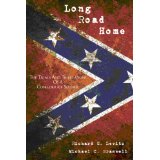
Long Road Home:

The Trials and Tribulations Of A Confederate Soldier


By Richard G. Zevitz
  Michael C. Braswell


In a well-researched, in-depth dramatization, Richard G. Zevitz and Michael C. Braswell centers in on an overlooked military campaign as both the North and South recognized the importance of the Mississippi River to war efforts. Historians will have an opportunity to follow the battles that occurred, as seen by those that were actually there--as soldiers.

Readers will follow Lt. Eli Forrest and his friends as they first learn to fight and then watch as they suffer through the hardships or the few good times. One of the things quickly discovered was how the men viewed the competency of their superiors, knowing that many of their friends and neighbors were being killed because of the actions of these men. We learn how Ft. Donelson, Ft. Henry, New Madrid, Island No. 10, Ft. Pillow were all taken--often through surrender.

Eli Forrest is a very likable guy. He had just been sent into this area, having been demoted from Captain to Lieutenant when the daughter of his previous ranking officer had different ideas about their relationship than Eli did... In other words he had not been interested in marriage...
He met George Spears when he was brought to help reinforce Fort Donelson, which was a long way from his home in Alabama. When Eli asked George if he had any tobacco, George didn't quite know what to say--he was a private and Eli, an officer. Eli quickly told his tale about being demoted--perhaps he felt better around the enlisted men now, especially since he didn't know any of the officers either. No matter why, they bonded and became like brothers.

In fact, when George later sneeked out, as many were doing after another loss, George, though, was heading to be with his own brothers further South. And sure enough, Eli followed... George's brothers were Will and A.F., the latter being of concern to his brothers--even though he was big and strong, his mind was that of a boy of 12. He had run away from home to join his brothers, accepted as a man, but not thinking as one... It didn't take long before Eli was also friends with the three brothers, staying close when possible, even though he had started staying in officers quarters.

Fighting battle after battle, in camps that had little food to ones which did, but no guns, the four friends shared whatever they could, until they were once again in a battle where a surrender was negotiated, this time winding up in a prison camp. In fact, a significant issue of the book is the treatment of the soldiers while at Camp Randall Military Prison in Madison, Wisconsin.

Eli had some medical training and experience so began to help with the wounded or those who became ill due to the bad conditions there. The three brothers had a much worse experience...

Both Eli and George had found love interests, but there was so little time that those relationships were mostly in their minds, helping to make their time more enjoyable as they thought about their new friends and wondered about whether there would be a chance for a future with them.

And then the war was over...

For those who want to go deep into the actual war battles and the lives of those who fought, this novel is an excellent, realistic presentation, with details sometimes so stunning that it is hard to accept that some men can be so cruel and that young boys were fighting with so little support. Historians, if you have not read much about this area of fighting, then I want to highlight that there are several area maps and an extensive bibliography and specific referencing for each chapter. Highly recommended.


GABixlerReviews


Richard G. Zevitz

A former division director for the Sheriff's Department in San Francisco, Richard Zevitz also worked for a neighborhood legal aid society. He earned four degrees including a degree in history and economics, a Doctorate in Criminology from the University of California at Berkeley and a Juris Doctorate from the University of Nebraska. He is currently Associate Professor of Criminology and Law Studies at Marquette University. Richard has published more than two dozen journal articles, including an article on Confederate prisoners of war at Camp Randall Military Prison in Madison, Wisconsin.

Michael C. Braswell

A former prison psychologist and marriage and family therapist, Michael Braswell earned four degrees in counseling and psychology, including his PhD from the University of Southern Mississippi. He has taught ethics and human relations for more than 30 years and is currently Professor Emeritus at East Tennessee State University. Michael's books include Morality Stories, Justice, Crime and Ethics, and the forthcoming Interview with Joab.
Enhanced by Zemanta

Tuesday, November 13, 2012

Paulette Mahurin Provides Excellent Debut Novel!


I love the cover of this novel by Paulette Mahurin, don't you? It perfectly sets the approximate period of time and allows us to better envision the cast of characters...and what a cast...

Please travel with me back to 1895 into a small town in Nevada. The first thing I learned was that world news was delivered by telegraph and posted centrally to be read by citizens.
the Dreyfus Affair divided France; Booker T. Washington gave his Atlanta address; Richard Olney, United States Secretary of State, expanded the effects of the Monroe Doctrine in settling a boundary dispute between the United Kingdom and Venezuela; and Oscar Wilde was tried and convicted for gross indecency under Britain’s recently passed law that made sex between males a criminal offense.
This poignant story is sad and yet beautiful... Mahurin has put it all right out there in her debut novel--all of the internal feelings in the world that are used to either love and support others or to destroy and hurt. It comes to mind that, in many ways, if the clothes on the cover were updated to the present and some of today's headlines replaced those for that year, that in many parts of the country, this story could easily hone in on what still happens in America. Perhaps that is why the author chose this as her topic? For whatever reason, his historical-looking novel is just as important, timely and relevant today as it was in 1895!

One of the significant additions I especially enjoyed was relevant quotes at the beginning of each chapter by Oscar Wilde. Although he appears in the novel only through news releases, he soon becomes the main individual around which...the gossip begins...

The Gossiper 
by Jean DeBuffet
"In contrast to Mildred, Josie thrived 
on being the center of attention.
Outside of them both being women, 
there was absolutely no similarity 
in appearance between the two. 
Whereas Mildred was a large woman with
 a face masculine in appearance, 
Josie was pretty in a feminine way with
 curved lips and eyebrows that accentuated 
her blue-green eyes and overly
 dilated pupils seeming always to be alert
 like an animal stalking prey. 
Were Josie to have a different personality
 or attitude she could be beautiful, 
like Edra, but her demeanor was so distasteful
 with constant faultfinding in others
 that it cast a dark ugliness over her.
 The mere comparison of Edra to Josie,
 for Mildred, was like comparing good with evil, 
beauty with ugliness, complete opposites 
that had nothing desirable in common."
 http://www.nashersculpturecenter.org
/object.aspx?ObjectID=21. .


Every town, every church, every organization seems to have at least one--she feels it is her responsibility to pinpoint issues of major importance--to be discussed, embellished, passed on, and regurgitated again and again. She also normally has an entourage who are not quite so bold, but who are quite willing to pass on the latest as presented by that woman--the town gossip! I cringe at the potential damage done by this type of woman. I must say that this author has "nailed" her perfectly and I enjoyed very much hating her and wanting her to be...
punished... Did you ever notice that America has a tendency to send such an offender away, rather than dealing with the situation? Nevertheless, the ending was appropriate, for that time...

Mildred Dunlap was the recipient of emotional abuse from this woman since she was a small child... But it had affected her greatly even if she never responded or shared her feelings. Mildred was now a wealthy woman who had inherited much from her father. She quietly used that wealth to help many people in that small town, but she was still hated by some and always someone who the town gossip included whenever she could.

But the latest news about Oscar Wilde had caused her great fear, for she knew that it would result in much discussion about why he had been arrested.

She immediately began to plan how to protect herself and her cousin, Edra, who, after being sexually abused at an early age, lived in fear thereafter, and had ultimately turned to Mildred for the love she needed...

She (and I) both wondered what would have happened if she had never started, but it was too late...

A local woman had died after a long illness, and as it was normal for neighbors to be visiting the home, helping when they could, Mildred decided that she should let him know she was interested... Edra was not happy about her plan...

Mildred thought this would be safe, thinking that he would never consider her seriously because of her own looks! It is impossible to merely tell you what happened in that little town, mostly when Josie opened her mouth!
But, there were also good people in that town...and they simply began to act as they felt they should...

Intense, disturbing, I found myself totally immersed in concern for Mildred and Edra. But I also had great empathy for Gus, a man who ran the local store, who had hidden the truth his entire life, by simply showing another person to the world. We are all so different from each other. Paulette Mahurin shows us, however, that we are all so very much alike! There is much to learn through her story if we open our hearts to what is said.

May this book be read widely and Mahurin's story be recognized for what it says to each of us--all of us!

And just an added note for the present lives we live...That gossiper is easily talking to many more these days. Please watch what you say on whatever social network you join...

Mahurin certainly "shows, not tells" us as this wonderful writer has easily entered into her character's true nature and captured what drives each to do what we choose. Listen and learn and perhaps we can all work to stop the persecution of one of today's citizens named "Mildred Dunlap"! Bullies are alive and well in 2012... History fans will enjoy the context and setting, but this drama deserves far-reading attention. Kudos to the author!


GABixlerReviews


Paulette Mahurin is a Nurse Practitioner who lives in Ojai, California with her husband Terry and their three dogs—Eli, Max, and Bella. She practices women’s health in a rural clinic and writes in her spare time.


Enhanced by Zemanta