


Peace Walking Through a Storm
How a line of monks exposes the moral weather of America today
They came walking as if the world had not yet taught them to hurry.
The monks moved in single file, robes brushing the winter air, each step a soft rebuttal to the nation’s rising clamor. Their silence is not retreat. It is testimony. In a country vibrating with fear, raids, and the cold machinery of federal power, their calm feels like a counterargument written in human form. They walk with the unbothered rhythm of people who know that truth does not need amplification to be heard.
America, meanwhile, is loud, loud with suspicion, loud with enforcement, loud with the grinding gears of a government that too often forgets the people inside its policies.
Yet these monks walk as if to say: Noise is not authority. Stillness is not surrender. Their presence does not quiet the storm; it reveals it.
When the monks walked out of the Huong Dao Buddhist Temple/Vipassana Bhavana in Fort Worth, Texas, on October 26, 2025, on foot en route to Washington, D. C., few could see the storm brewing in America. Perhaps the monks sensed that America was a powder keg, ripe for explosion and in need of a cooling-off period.
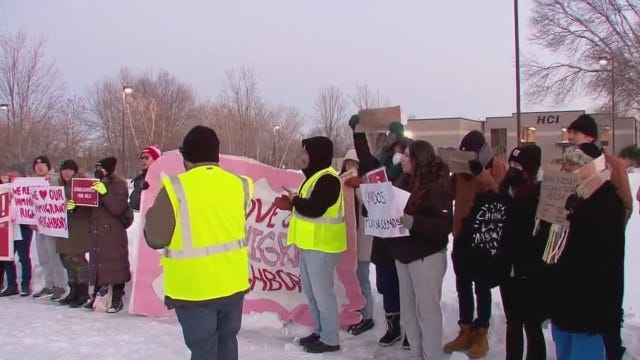
Photo from the Internet.
The official language is always the same: “procedures,” “protocols,” “enforcement actions.” But beneath the bureaucratic phrasing lies a simple reality. Fear has become a governing tool. Keep the populace in fear, stressed out, full of worry and concern, then willy-nilly govern at your pleasure.
Into this atmosphere stepped the monks, unarmed and unafraid. Their walk is not a traditional protest. They do not chant. They do not carry signs. They do not demand anything. They moved through the nation like a slow-moving mirror, reflecting the moral cost of our choices.
Their silence asked a question the country has been avoiding: What kind of nation requires this kind of walk?
This question becomes all the more important when one realizes that we are two Americas, side by side. Neither resembles the other.
As a journalist, I might describe the scene in terms of contrast: On one side, federal agents in dark uniforms, radios crackling, vehicles idling, tear gas smoke filling the air, the choreography of state power on full display. On the other, monks in saffron robes, hands folded, eyes lowered, their only weapon the steadiness of their breath.
A prophet like Isaiah or Jeremiah would frame it differently: One America is ruled by fear. The other is ruled by memory — the memory of who we said we were, and who we still might become.
A poet like James Baldwin would see the contrast in color and motion: the sharp lines of enforcement against the soft geometry of devotion; the clipped urgency of command against the unhurried cadence of prayer.
Both Americas are real. Only one, Baldwin would urge, is sustainable.
Baldwin taught me to bear witness and to speak of an American, “No better than I have seen.”
I have lived long enough to recognize this moment. I have seen federal power used to protect me on the first day of integrating the Lanier Jr. High School for Boys in Macon, Georgia, and I have seen it used to intimidate me as a criminal defense lawyer representing my clients in Hancock County, Georgia, and Butts County, Georgia.
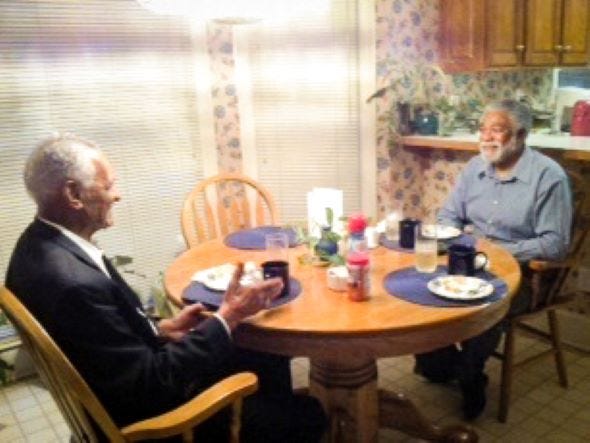
On his 95th birthday at the close of the last decade, I asked Presidential Medal of Freedom recipient Rev. C. T. Vivian, who had lived so long, what he thought of the Black Lives Matter protests. Vivian answered, “The kids blow it. They had the government in the palm of their hands until the rioting and looting started.”
I have watched peaceful walkers before — in Birmingham, where I marched not with Dr. Martin Luther King, Jr., but with Jesse Jackson, in Fort Valley, Georgia where I marched with Hosea Williams, in Macon, Georgia, where I marched with Dr. Joseph E. Lowery, and in the long shadow of Tuskegee with people who carried the moral weight of a nation on their shoulders simply by refusing to move in anger.
The monks remind me of that lineage. They are not marching against ICE. They are marching for the soul of the country.
Their walk calls forth memories of earlier reckonings, when ordinary people stepped into the streets not because they were strong, but because they were right. And like those earlier walkers, the monks understand something essential: that moral authority does not shout. It stands. It walks. It endures.
We are twittering on the prophetic edge with full knowledge that prophets do not predict the future; they diagnose the present. And the diagnosis is clear: A nation that treats its people as threats will eventually become a threat to itself.
The monks’ walk exposes the spiritual cost of our policies. It reveals how easily a government can drift from protection to punishment, from order to oppression, from vigilance to fear. Their silence is not passive; it is surgical. It cuts through the noise and lays bare the truth:
We are living in a time when compassion is treated as naïveté and enforcement as virtue.
But the monks insist on another reading of the moment. Their walk says: A nation is not measured by the strength of its borders, but by the breadth of its humanity.
Here is what their walk reveals about us:
In the end, the monks do not indict America with words. They indict America with presence.
Their silence becomes a mirror. Their calm becomes an indictment. Their steps become a prayer for a country that has lost its way.
They remind us that the measure of a nation is not how it treats the powerful, but how it treats the vulnerable. They remind us that dignity is not a privilege to be granted, but a birthright to be honored. They remind us that fear is a poor architect for a democratic home.
And perhaps the most urgent reminder is this:
The monks do not come to condemn America. They come to remind America of the promise it once made to itself — that dignity is not negotiable, and humanity is not optional.
As the heathens rage with long guns drawn in the snowy streets of Minneapolis, the monks walk up the eastern seaboard, offering an interesting contrast.
Their walk is not a protest to the violence they know is happening in America. It is a prophecy. A quiet one, yes, but “quiet things have always had a way of outlasting storms,” wisdom according to C. T. Vivian.
~~~~
When Peace Meets Fear
The Quiet Tensions Along the Walk for Peace

An Evangelical Baptist in Monroe, Georgia attempting to convert the Monks to become Jesus worshippers. Photo Screen Shot from Baba Omaloh’s TikTok
For weeks, the Buddhist monks walking from Texas to Washington, D.C. have moved through the South like a soft wind — steady, humble, and unthreatening. Their message is simple: peace begins within. Their method is ancient: walk, breathe, bless, repeat. And their presence has drawn thousands into moments of unexpected unity.
But as their visibility grows, so does something else:
The quiet resistance that always rises when peace enters a space where fear has been living comfortably.
Most of the country sees the crowds, the thousands who gather in cold weather, the families who bring food, the churches that open their doors. But on the edges of this movement, minor confrontations are beginning to surface, not in the mainstream press but in the digital spaces where many Americans now live their public lives.
These moments are not the story of the walk. But they are part of the story of America.
.webp)
Will Butler, Georgia Executive Director for Frontline Response, International
hosting the monks in DeKalb County, Georgia, December 28, 2025. Photo credit
Will Butler
In Monroe, Georgia, a small group appeared with picket signs, not many, but enough to signal discomfort. On social media, a lone protester confronted the monks directly, warning them that they were “walking to hell” and “taking their supporters with them.” And in another Georgia town, a church called the police simply because the monks were walking past their property.
None of these incidents escalated. None became violent. None drew the attention of major news outlets.
But they reveal something important: peace does not move through a society without stirring the fears that lie beneath its surface.
These reactions are not about the monks.
They are about the people who feel threatened by what the monks represent.
What has struck me most is not the resistance itself, but the monks’ response to it.
When confronted with condemnation, they said: “Let them say what they want to say.”
When crowds grew tense, they reminded everyone: “Everyone has the right to express themselves. Focus on the peace within you.”
.webp)
The Venerable Monk charged with leading the monks on a 2300-mile trek for peace. Photo by Will Butler
And yet, these reactions also reveal something hopeful: the overwhelming majority of people respond to peace with openness, curiosity, and gratitude. For every protester, thousands are standing in silence, waiting for the monks to arrive. For every harsh word, there are countless gestures of kindness. For every fearful reaction, there is a community ready to embrace the moment. The tension is real, but so is the hope. When I stood among more than 5,000 people in Fayetteville, Georgia, waiting in the cold for the monks to arrive, I saw the best of what we can be. The sky was gray, the wind sharp, the morning heavy. But when the monks appeared, the clouds broke, and the sun poured through as if the day itself had been waiting for them. That moment felt like a blessing. But I also know that not everyone sees what I saw. Some see danger where there is none. Some see a threat where there is only humility. Some see spiritual competition where there is only compassion.
And that, too, is part of the American story. For all the warmth that has greeted the monks across Georgia, their walk has also stirred a quieter, more complicated response. The kind that rarely makes the evening news but spreads quickly through the digital spaces where many Americans now form their understanding of the world.
.webp)
Will Butler with Akola trusted friend and companion of the monks.
Photo from Will Butler
In Monroe, a small group appeared with picket signs. On social media, a lone voice confronted the monks directly, warning them that they were “walking to hell” and “taking their supporters with them.” In another Georgia town, a church called the police simply because the monks walked past their property. These incidents were isolated but revealing. They showed that even a message as gentle as peace can unsettle those who fear what they cannot categorize.
What struck me most was not the resistance itself, but the monks’ response to it. “Let them say what they want to say,” they told their followers. “Everyone has the right to express themselves. Focus on the peace within you.”
The monk’s posit was not resignation. It was discipline, the same spiritual clarity that has sustained peacemakers across centuries. Their posture echoed the teachings of Jesus on the hillside, the resolve of Dr. King in Birmingham, the quiet courage of Gandhi on the long road to the sea. Peace, when practiced sincerely, does not flinch at fear. It absorbs it, transforms it, and keeps walking.
When the protestor in Monroe, Georgia, proclaimed that the monks were “walking to Hell,” the Venerable monk replied, “It’s okay, then let me go.” The monk added, “Are you at peace?” The protestor feigned that he was, then, as when Jesus was run out of the Synagogue and driven to the edge of the cliff before parting the crowd and walking past his persecutors, the protestor, blocking the monks’ movement, moved as the monks marched through his line of resistance.
These minor flare-ups do not define the walk. But they do reveal something about the American moment: that we are a nation still deciding whether we recognize peace when it approaches us, or whether we recoil from it out of habit, suspicion, or inherited fear.
The monks are not here to convert anyone or challenge anyone’s faith. They are here to hold up a mirror. And in that mirror, we see both our generosity and our anxieties, our openness and our reflexive defensiveness.
When the Monks reached Decatur, Georgia, they were met not with resistance but with the warmth of brotherly love in the person of Will Butler, Georgia Executive Director for Frontline Response International. Butler runs a shelter for the unhoused in Decatur. He was tasked with feeding the monks and housing them overnight at the Tobie Grant Recreation Center in DeKalb County, Georgia. Butler, whose mother is an ordained minister of the gospel, said, “It was truly an honor and pleasure for the Frontline Response team to provide overnight hospitality services to the Venerable Buddhist Monks.
Witnessing all walks of faith and even non-believers coming together peacefully and respectfully in one place was awe-inspiring, and this moment in history will forever be remembered and forged into our hearts.” Leaving DeKalb County, Georgia, their journey continues.
The question remains.
The monks are not here to convert anyone.
They are not here to challenge Christianity or any other faith.
They are not here to win a debate.
They are here to ask a question, not with words, but with their walk:
It is a question that reveals more about us than about them.
And as they continue toward Washington, step by step, blessing by blessing, mile by mile, they invite us to choose, not between religions, not between ideologies, but between fear and compassion.
The monks have already chosen their path. The question now is whether we will choose ours.
After all, whose side is God on?
When religion becomes divisive, it is no longer from the God who created ALL...When religion becomes more important than God's Love, it is no longer of God...This is what I believe. and as illustrated by Michael through his words and wisdom... Many have died based upon somebody's opinions of what religion they choose means...
But when you choose God, the Father
You may recognize His Truth His Love...
and find religion is of little value if Love is not present...
Gabby


No comments:
Post a Comment